

How To Remove Fly Away Hair In Lightroom
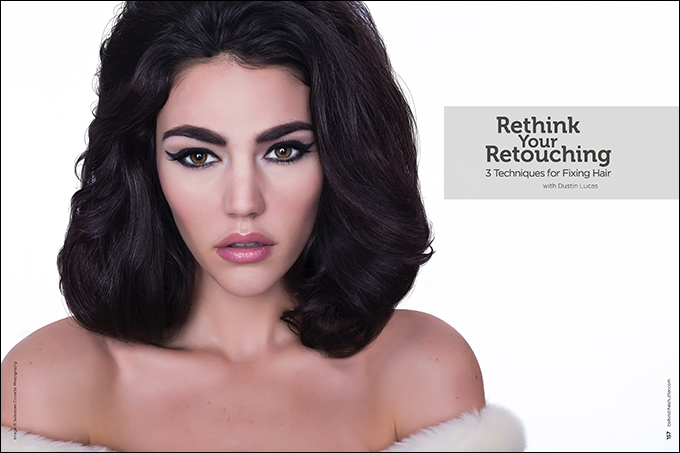
Rethink Your Retouching: iii Techniques for Fixing Hair with Dustin Lucas
Desire more than information on this commodity? Get admission to video content and additional supporting images. Launch the January issue of the magazine past logging in or signing up for a complimentary business relationship by clicking here . Shutter Magazine is the industry's leading professional photography magazine.
Whether you're shooting beauty, fashion or glamour, pilus tin can exist a huge distraction. Hiring a makeup and hair artist can be a game changer, but there is still plenty of work to be done afterwards the shoot. Things like stray hairs can really describe attention away from your bailiwick'due south face and cause them to get tangled in the pilus. It doesn't have to be this style.
Some familiar tools, like the Clone Stamp and Healing Castor, are cracking for removing flyaway hairs. Removing these distractions is easy, but making it look realistic tin be hard. That's where a technique called "frequency separation" can be crucial. Adding hair seems odd but can keep your editing looking equally natural as possible. As we all know, when using Photoshop, if something is off, it looks fake.
We will be working with layers and then that the file remains nondestructive. Although creating layers increases the file size, I highly recommend it. Along with layers come masks and clipping masks. Masks allow specific areas of an image to exist affected by increasing the transparency of the effect. With a black layer mask, none of the effect is applied, and white means it is 100% transparent. This is where brush opacity allows you to utilize subtle amounts of the consequence as well. Blending modes chronicle to how the event is practical rather than the amount.
The Clone Stamp
At present allow's go working in Photoshop. Open your image and create a blank layer. It is all-time to exercise all your work on a split up layer and so that your original image, or base layer, is non affected. Select the Clone Stamp tool to remove the flyaway hairs. Navigate to the sample setting and set to Current and Below. Adjust your brush to take a softer border; difficult edges make the cloned areas await patchy. Before yous brainstorm painting, y'all must select a sample source—I suggest making your castor smaller and choosing an area similar to where the hair you want to remove is. To practise this quickly, hold down Option, click and then paint over the hair. To resample your source, repeat the previous stride. Remove all the flyaway pilus.
Create a layer mask by holding down Option and clicking the keepsake at the lesser of the layers palette. This makes a black layer mask that hides all the work we merely did. Select the paintbrush with a much harder edge and chose white every bit your foreground colour. You lot can now pigment back in the cloning piece of work. Cull a lower-opacity brush to help blend everything together.
To remove crosshairs, select your sample source and begin painting. This is a very deadening and difficult process. There are a couple of blending modes that can help with lighter and darker hair. Set information technology to lighten for lighter hair in darker backgrounds, and darken for darker pilus in lighter areas. It is difficult to be precise with this tool, and this type of editing should exist saved for a different technique. I'll become into that subsequently.
The Healing Brush
For seamless backdrops and continuous backgrounds, this works well, only I want to work a lilliputian more than precisely. Create a new layer, grab the Healing Brush and prepare the samples setting to Current and Below. Select a soft-edge brush so that the blending is less noticeable. Choose a sample source and begin removing the flyaways. Yous will notice every bit soon every bit you get also close to the edge, the blending goes to crap. This is where you can utilize the Clone Tool to swap back and along with the Healing Brush. Apply hotkeys to do this speedily; the Clone Stamp is "s" and the healing brush is "j."
Once you remove the unwanted hair, it is a good idea to add together some back in so the cleaned-upwardly areas don't expect fake. Create a new layer and choose the paintbrush. Adjust the brush'south edge to 100% hardness, gear up the brush size to ane to 3 pixels, and color-pick a department of the hair toward the border. To quickly toggle colors, hit the "I" key and click in an area, then hit the "b" key to switch back to the brush. Begin drawing long strokes around any curves or to fill in gaps in the hair. Stay close to the edge and draw from within outward. Repeat strands in an surface area to create some volume.
Now you need to blur these strokes to create depth. From the menu bar, cull Filter > Blur > Gaussian Mistiness. Prepare the radius to friction match the sharpness of the surrounding pilus—I used ii.4 for this example. Then add noise by going to Filter > Racket > Add Noise. I zoomed into the image at 100% to attempt to lucifer the groundwork, and settled with 9.v% noise. These two adjustments brand all the departure in creating realistic strands of hair.
Frequency Separation
This technique is built around the aforementioned process for softening skin and prototype sharpening. Using the Gaussian Blur and High Laissez passer filters, you tin start to remove crosshairs much more accurately than our earlier technique with the Clone Stamp. Showtime we need to duplicate our image layer. From the menu bar, choose Filter > Blur > Gaussian Blur. Set up the radius to fourteen pixels and click OK. And then duplicate your image layer over again and choose Filter > Other > Loftier Laissez passer. Set the radius to 10 pixels. Make an action for this. I downloaded a gratis ane from FX-Ray.com. No need to make this step any harder—set up an action to rapidly create these layers.
Advertisement

Once I accept the layers built, I am ready to assault the crosshairs. These can exist difficult to remove, every bit we saw when we used the Clone Stamp on an empty layer. That is why we created the frequency separation layers. Select the loftier-frequency layer and strike Command + J to immediately duplicate the layer. Then nosotros need to convert it to a clipping mask by striking Shift, Command + 1000. This allows the Clone Stamp to affect simply the layer below in specific areas. It's a much more than precise technique for cloning crosshairs. Strike the "S" key, choose a sample source and begin painting in the management of the hair strands. Resample and move the cursor to get the right look. You lot will need to change the blending fashion to Normal for the layer and the Clone Stamp tool. You also need to change the sample setting to Electric current Layer.
Accept your time and learn to sample. I similar to remove a big slice of hair by sampling side by side to it and painting over it entirely. You do not have to be precise at beginning, considering y'all can clean up by dragging the cursor the same direction as the rest of the hair later. Painting in the same direction is crucial to creating continuity with the cloned strands of pilus.
The Results
Retouching pilus can be as stressful as you want to get in. Go used to the tools and the sampling technique to get more than precise with your editing. A Wacom tablet is extremely helpful, just I completed this tutorial with a mouse.
Recollect, when working in Photoshop, it's more about what looks right merely likewise not spending days on end to perfect an image. These techniques will get you in a proficient place, and edifice on them can revamp your retouching abilities.
Want more information on this article? Get access to video content and boosted supporting images. Launch the January event of the magazine past logging in or signing up for a gratuitous account by clicking here . Shutter Magazine is the industry'south leading professional photography magazine.
Source: https://www.behindtheshutter.com/rethink-your-retouching-3-techniques-for-fixing-hair-with-dustin-lucas/
0 Response to "How To Remove Fly Away Hair In Lightroom"
Post a Comment